About
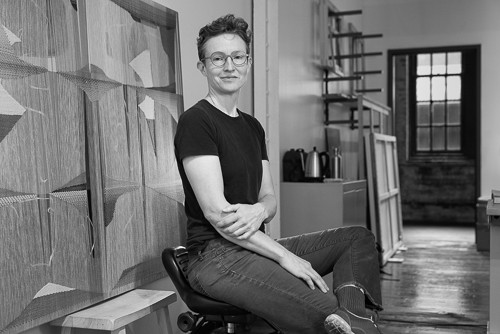
Jen P. Harris (they/she) received their MFA from Queens College of the City University of New York (Flushing, NY) and a BA in Studio Art from Yale University (New Haven, CT). Selected solo shows include: Patricia Sweetow Gallery (Los Angeles, CA), Abattoir Gallery (Cleveland, OH), St. Ambrose University (Davenport, IA), Rockland Center for the Arts (West Nyack, NY), John Davis Gallery (Hudson, NY), Daniel Cooney Fine Art (New York, NY), Leslie-Lohman Museum of Art (New York, NY), and Delaware Contemporary (Wilmington, DE).
Selected group shows include: Special Effects (Kansas City, MO), Jane Lombard Gallery (New York, NY), Abigail Ogilvy Gallery (Los Angeles, CA), Burchfield Art Center (Buffalo, NY), Essex Flowers (New York, NY), Ortega y Gasset Projects (Brooklyn, NY), Public Space One (Iowa City, IA), University of Iowa School of Art (Iowa City, IA), Sardine (Brooklyn, NY) and the Wassaic Project (Wassaic, NY).
A 2025 recipient of the Pollock Krasner Foundation Grant, Harris has been an artist-in-residence at the Edward F. Albee Foundation (Montauk, NY), Virginia Center for the Arts (Amherst, VA), Praxis Digital Weaving Lab (Cleveland, OH), Women’s Studio Workshop (Rosendale, NY), Vermont Studio Center (Johnson, VT), and the Yale-Norfolk Summer School of Art (Norfolk, CT), among other places. Their work has been supported by grants from the Andy Warhol Foundation for the Visual Arts, Puffin Foundation, New York Foundation for the Arts, and Astraea Lesbian Foundation for Justice, and has appeared in publications such as the New York Times, Fiber Art Now, New Art Examiner, Tussle, CultureCatch, Guernica, and the Philadelphia Inquirer.
Harris’s work is represented by Patricia Sweetow Gallery in Los Angeles and Abattoir Gallery in Cleveland. The artist lives and works in Cleveland, OH, following significant stints in Los Angeles, New York, and Iowa City.
About the work
My loom-paintings are both painting and weaving, and they resist fitting neatly into either category. Each piece begins as a traditional painting might, with a stretched canvas and layers of paint, which I transform into a simple loom by hammering nails across the top and bottom, installing a warp vertically across the painted surface, and weaving horizontally with hand and needle. The hybrid nature of each loom-painting emphasizes the slippage between painted and woven elements, forming a dialectical space in which the two meet to conjure shifting bodily and spatial subjects. Some works, like Night Swimming (2026), articulate this transformative exchange through tension: woven shapes tug on vertical warps to reveal slices of the painted field below. Optical vibration also plays a role, playing with our perception to propose a fluid field of vision and meaning. The work engages with traditional textile practices, historical painting lineages, and the graphic language of drawing, bringing an intuitive approach to image-making into conversation with a technical approach to tapestry weaving, a visceral understanding of color, and a cartoon-like use of line. In holding these various modalities in tension, the loom-paintings collapse clear distinctions and binaries, privileging fluidity as both visual and philosophical condition.
Studio portrait by Jacob Koestler